

Reading time: 1 minute
The European Green Deal, with measures such as the Taxonomy Regulation [1], Green Public Procurement Criteria [2], Ecodesign Regulation for sustainable products and Circular Economy Action Plan [4], paves the way for a circular construction industry. Implementation means rethinking the development, manufacture, use and end-of-life of construction products.
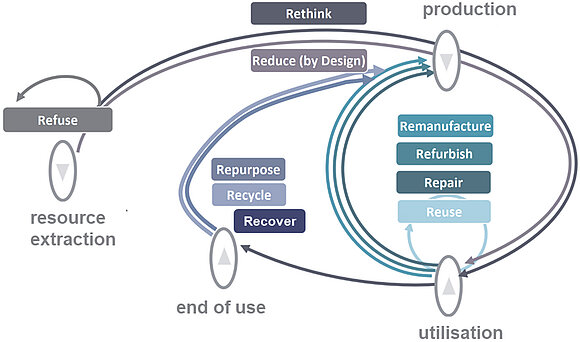
The general 9R model of the circular economy defines ten general principles (R0-R9) for possible fields of action. Depending on the product, different priorities and options arise in the individual fields of action.
As an essential component of the building envelope, windows and doors are of great importance for a future circular construction industry. However, there has been no systematic and objective analysis of the potential for complex building elements such as windows and doors in the individual fields of action of the 9R strategy. Due to the complexity of windows and doors as building elements, the use of many different materials and components and the variety of their combinations, with differing manufacturing processes and long service lives, a systematic analysis of the building element is necessary for evaluation.
The overarching goal of a research project currently underway at ift Rosenheim is to identify potential areas of action for the 9R strategy for complex building components such as windows and doors, and to develop a concept for classifying recyclability.
9R strategies
The R strategies provide assistance for the systematic implementation of the circular economy and the transformation towards a circular economy. These strategies are all aimed at reducing the consumption of natural resources. To achieve this goal, options for action are defined and arranged in a hierarchy.
The first step is to refuse to extract raw materials or manufacture a product, and the last step is to recover (thermally recycle) the materials used. The individual R-strategies are outlined below.
R0Refuse
Make components of the product, production process or function redundant; provide the function in a different way
R1 Rethink
Take a systemic view, plan and design for cycles (also plan circular systems around the product, including reverse logistics), develop new business models, consciously choose materials for cycles (substitution of questionable substances, material innovations). Intensify product use (e.g. through product-as-a-service, reuse and sharing models, or by offering to bring multifunctional products to market)
R2 Reduce (by design)
Implementation of a design that enables circularity. Increasing efficiency in the manufacture or use of products by consuming fewer natural resources, materials and energy, reducing the ecological footprint, including use.
R3 Reuse
Reuse of a product in accordance with its original function (after minor treatment/ repair) by placing it back on the market.
R4 Repair
Maintenance (servicing and repair) of a product to restore or maintain its performance to its original new condition.
R5 Refurbish
Restoring/rebuilding and upgrading a product that no longer meets the necessary/ expected performance standards. Improving performance compared to the original new condition.
R6 Remanufacture
Restoring a product to a condition that is as good as or better than new in terms of both quality and performance through an industrial process.
R7 Repurpose
Using a product or components of a product in a product with a different function
R8 Recycling
Stoffliche Verwertung der Materialien des Produkts oder chemische Aufbereitung zu Rohstoffen
R9 Recover
Thermal recycling of the product's materials and processing into materials intended for use as fuel
Circulatory capacity
The relevant product data is required to determine the life cycle assessment of a building. The product data is transmitted to the building certifier via corresponding EPDs (Environmental Product Declarations). EPDs have become widely established in recent years. Manufacturers have also had such EPDs created for windows and doors. The Window + Facade Association has had so-called sample EPDs developed at ift Rosenheim.
In order to determine the circularity of a building, the relevant data will also have to be submitted to the certifier in future. Analogous to EPDs, this could be done in future by means of CPDs (Circularity Product Declarations) or by combining EPDs and CPDs (note: the term CPD does not currently exist officially). The digital product passport (DPP) is to serve as the means of transporting all the data in future.
As part of the project, it is now necessary to define which data is required here and under which conditions this data is to be determined for windows and doors. The 10 circularity properties currently required by the DGNB assessment system [6] are shown below as examples.
- ZE01: Hazardous substances contained
- ZE02: Post-consumer recycled content
- ZE03: Ease of maintenance and repair
- ZE04: Proportion of renewable raw materials
- ZE05: Biodegradability
- ZE06: Dismantlability (from the building structure)
- ZE07: Separability (materials)
- ZE08: Products with a long service life
- ZE09: Reusability/recyclability
- ZE10: Reuse/reutilisation
An analysis of the requirements of other building certification systems such as LEED or BREAM with regard to the circularity of building products is still pending.
Outlook
The research project will officially run until January 2027. As part of the project, the following additional topics will be addressed in collaboration with the project partners:
Reuse and refurbishment of components and assemblies
This work package analyses reuse and refurbishment strategies from the perspective of how ‘used’ or already installed components and building components/materials could be tested, certified and approved. This particularly concerns open questions regarding warranty and liability as well as the declaration of performance characteristics within the framework of CE marking.Predictive maintenance
This work package examines whether and how predictive maintenance could have a positive impact on the service life of windows and doors and, in particular, on ensuring the necessary performance characteristics. To this end, it is necessary to analyse which parameters would need to be determined in order to indicate timely maintenance and repair. Furthermore, it is necessary to determine which ‘sensors’ would be required for this purpose and how they could be integrated into the building component.Digital product passport
This work package analyses the opportunities and risks of a digital product passport, particularly in the context of circular construction. Proposals are developed regarding the quality and level of detail with which the relevant information must be available when the product is new (e.g. materials, geometries, manufacturer). In addition, an analysis is to be carried out to determine what further information needs to be updated in a digital product passport during the product's service life (e.g. replacement of components, materials used during maintenance, further information).
Acknowledgements
This research project is funded by the Federal Institute for Research on Building, Urban Affairs and Spatial Development on behalf of the Federal Ministry of Housing, Urban Development and Construction with funds from the Zukunft Bau research funding programme.
The following project partners are supporting the project both in terms of content and financially:
Bundesverband Flachglas, Gutmann, Finstral, Jansen, Hydro Building Systems, Raico, Remmers, Holz Schiller, Schüco, Siegenia, Timm Fensterbau, Velux, VEKA, Verband Fenster und Fassade e.V..
Bibliography
- Verordnung (EU) 2020/852 des Europäischen Parlaments und des Rates vom 18. Juni 2020 über die Einrichtung eines Rahmens zur Erleichterung nachhaltiger Investitionen und zur Änderung der Verordnung (EU) 2019/2088
- Communication from the Commission to the European Parliament, the Council, the European Economic and Social Committee and the Committee of the Regions Public procurement for a better environment {SEC(2008) 2124} {SEC(2008) 2125} {SEC(2008) 2126}
- Verordnung (EU) 2024/1781 des Europäischen Parlaments und des Rates vom 13. Juni 2024 zur Schaffung eines Rahmens für die Festlegung von Ökodesign-Anforderungen für nachhaltige Produkte, zur Änderung der Richtlinie (EU) 2020/1828 und der Verordnung (EU) 2023/1542 und zur Aufhebung der Richtlinie 2009/125/EG
- COMMUNICATION FROM THE COMMISSION TO THE EUROPEAN PARLIAMENT, THE COUNCIL, THE EUROPEAN ECONOMIC AND SOCIAL COMMITTEE AND THE COMMITTEE OF THE REGIONS A new Circular Economy Action Plan For a cleaner and more competitive Europe
- DEUTSCHE NORMUNGSROADMAP Circular Economy
Herausgeber: DIN, DKE, VDI
https://www.din.de/resource/blob/892606/06b0b608640aaddd63e5dae105ca77d8/normungsroadmap-circular-economy-data.pdf - DGNB System – Kriterienkatalog Gebäude Neubau
TEC1.6 Zirkuläres Bauen
Version 2023
https://www.dgnb.de/filestorages/Downloads_unprotected/dokumente/kriterien/dgnb-kriterium-tec-1-6-gebaeude-neubau-version-2023.pdf

Norbert Sack
Dipl.-Phys. Norbert Sack is head of research and development and working at ift Rosenheim since 1995. He participates in various national and international standards committees and committees of experts and is also a visiting lecturer at Rosenheim University of Applied Sciences.